

SolarWinds Brings “Resilience’ to IT Ops for Agentic AI and Autonomous Operations 
SolarWinds has a new AI-focused offering built to help IT Ops teams fill the “resilience gap” by brining deliver observability, resilience, and reliability to agentic AI and autonomous operations. IDN learns more with SolarWinds Matai Wilson, Head of AI Product.
by Vance McCarthy
Tags: agentic AI, governance, human-in-the-loop, IT Ops, resilience, SolarWinds,

Head of AI Product

"With SolarWinds AI Agent, there is nothing the end user has to configure or "set up" in terms of rules. The agent uses the existing IT environment data and its [SolarWinds] knowledge from day one."

Even prior to the AI era, enterprise systems routinely suffered from complexity and fragility. So, it would be expected for enterprise executives looking at adopting AI solutions to make “resilience” a top priority.
SolarWinds latest agentic AI innovations released late last fall are built to deliver responsive observability for IT ops teams to address the “resilience gap,” according to company execs.
In specific, SolarWinds AI Agent gives IT teams an intelligent, context-aware system that can predict issues and automates responses using easy-to-interact with conversational, agentic AI. The offering also looks to also smooth any planned transition to autonomous projects with “autonomous operational resilience,” execs added.
“Every IT leader is under pressure to do more with less, but outages and complexity continue to slow teams down,” said Sudhakar Ramakrishna, President and CEO, SolarWinds. “With the SolarWinds AI Agent, we are reducing the mean time to detect and resolve issues by putting automation, observability, visualization, and remediation into a single, intelligent cycle. The result is stronger resilience, greater productivity, and more time for teams to focus on innovation.”
How SolarWinds AI Agent Fills the “Resilience Gap”
In fact, to make SolarWinds AI Agent easy to adopt for existing IT professionals, it was designed to be a “digital team member for IT Ops,” added SolarWinds CTO Krishna Sai. In detail, SolarWinds AI Agent will function as a reliable teammate in observability, incident response, and service management, he said. This approach will enable IT professionals to:
Resolve incidents faster. Automatically summarize outages, gather diagnostics, identify probable root causes, and suggest remediation steps.
Use natural language. Ask questions about system health, compare metrics, get recommendations, and launch multi-step workflows—all with plain-language commands.
Simplify observability management. Configure and manage SolarWinds Observability directly through the agentic interface.
“The SolarWinds AI Agent is more than a feature—it’s a foundation for a new way of working, [helping] IT teams cut through complexity, respond faster, and shift from firefighting to innovation,” Sai added. “By embedding intelligent, context-aware AI into IT workflows, we’re helping teams move beyond reactive firefighting to proactive innovation.”
Moving "beyond reactive firefighting to proactive innovation" is the perfect summary, as the SolarWinds AI Agent is designed for both scenarios, Matai Wilson, Head of AI Product at SolarWinds told IDN.
To further illustrate IDN asked Wilson to share some examples of how SolarWinds AI Agents works in a real-life setting, and how much skills IT Ops team might need to configure and deploy it.
First, consider a reactive "firefighting" use case. An IT admin sees an alert for a network latency spike at 9 a.m. Instead of manually correlating metrics across multiple dashboards, they can simply ask the agent, "Why did this metric spike at 9 a.m.?" The agent instantly contextualizes this query with the dashboard they are viewing, the initial alert, and other relevant environment data. It might then respond that after analyzing the event, it found no related device errors and concludes the likely cause was temporary backend service latency. This immediately accelerates root cause analysis (RCA) and narrows the investigative path, reducing the mean time to resolution (MTTR) from hours to seconds.
Second, a more proactive, exploratory use case. An APM user might ask a high-level question like, "Which of my applications are in poor health?" The agent will query the health state data and present a list. The user can then drill down conversationally: "Why is Application X's health bad?" The agent might analyze the service and identify that its health is poor due to one specific critical alert, noting other performance indicators are normal. The user's next logical question, "What is that active critical alert?", gets them the exact alert details and a direct link to investigate further.
This conversational flow allows a user to move from a high-level problem to a specific, actionable root cause—all with persistent context and within a single interface.
This is a real-time capability that goes far beyond traditional, static alerts. There is nothing the end user has to configure or "set up" in terms of rules. The agent uses the existing IT environment data and its knowledge of how SolarWinds systems are architected to traverse them seamlessly from day one.
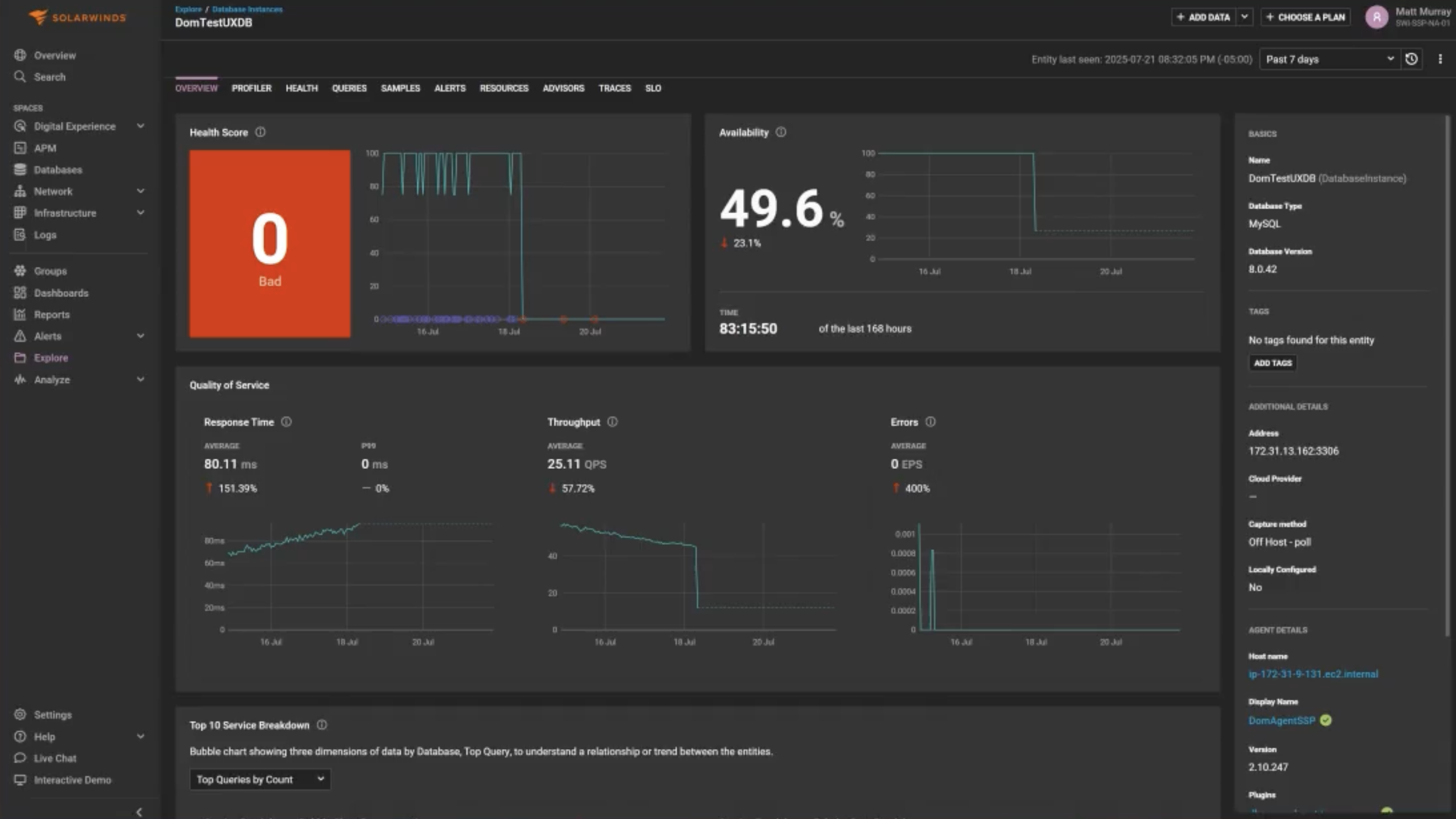
SolarWinds AI Agents Will Tap Other Capabilities for IT Ops-Ready Automation, Operational Resilience
Alongside SolarWinds AI Agent, the company also introduced new expanded AI-powered features targeted at the need of IT Ops teams, including:
- Root Cause Assist (Generally Available): Cuts troubleshooting time by generating clear root-cause analyses based on alerts and anomalies.
- Dynamic Threshold Enhancements (Available Now): Extends automated thresholding to additional metrics, decreasing noise and false positives.
- AI Query Assist (Tech Preview): Enhances database performance by analyzing query patterns and proposing faster, more efficient rewrites.
“For the past year, we’ve focused on operational resilience—the ability to protect, maintain, and quickly recover systems even during disruptions,” noted SolarWinds CEO Ramakrishna, “With the AI Agent and expanded capabilities, we’re taking the next step: helping customers achieve autonomous operational resilience, where IT runs smarter, faster, and more securely with minimal manual intervention.”
With this vision in mind of a transition to “autonomous operational resilience” in mind, we also asked Wilson whether SolarWinds suite of AI technologies may also support guardrails or even agentic governance to prevent over-eager agents from going rogue or not operating correctly.
This is a critical question and a core part of our design philosophy. For an agent to be truly autonomous, it must first be trusted, and that trust is built on safety and governance.
We are taking a deliberate, phased approach. Initially, the agent's power is focused on observation, analysis, and surfacing insights. We’ve built in guardrails that limit its ability to perform direct mutations or transformations on the underlying data within the IT environment.
For the actions it can take, we are implementing strict "human-in-the-loop" (HITL) governance. This directly addresses your concern. Before the agent executes a change or remediation, it will proactively prompt the user to confirm the proposed action and its expected outcome. This model ensures the hands-on worker always has final approval and prevents an "over-eager agent" from making an unwanted or unexpected change.
This HITL model provides the "safety valve" that mission-critical environments require. It also serves as a crucial training and confidence-building mechanism, allowing teams to validate the agent's recommendations as we pave the way for greater, trusted autonomy in the future.
SolarWinds has even more AI enhancements set for 2026, including incident correlation, automated runbook execution, and knowledge base creation to further improve autonomous resilience. Among more notable items are Incident Correlation and capabilities for a Knowledge Base for Service Desk to improve problem management workflow to address the root cause.
SolarWinds AI Agent and coming releases expand on the company’s well-known Secure by Design framework and are built on AI by Design principles
Related:
- Tray Enterprise-Class AI Platform Casts Light on “Shadow MCP” and Controls “AI Sprawl”
- Xano 2.0 Updates Production Grade Backend for AI, Apps To Solve "Vibe Coding Trap"
- Ai4 2025 Vegas Wrap-Up: What Enterprises Need to Know About Emerging AI Solutions
- Boomi Agentstudio Looks To Deliver Full-Featured Management Platform for AI Agents
- Agentic AI: Unlocking Business Value with the Next Evolution in Enterprise Intelligence
All rights reserved © 2025 Enterprise Integration News, Inc.